
Psychology student tools: practical guide
Studying psychology today means knowing how to integrate theory, practice and digital tools. This guide collects the main Psychology student tools for taking notes effectively, practicing with clinical simulations and critically consulting DSM-5 and ICD-11, with operational advice to immediately take your learning to a more aware and professional level. Soon, we will analyze the 5 main advantages of an approach oriented towards the use of concrete tools: clarity, continuity, feedback, standardization and transferability to clinical practice.
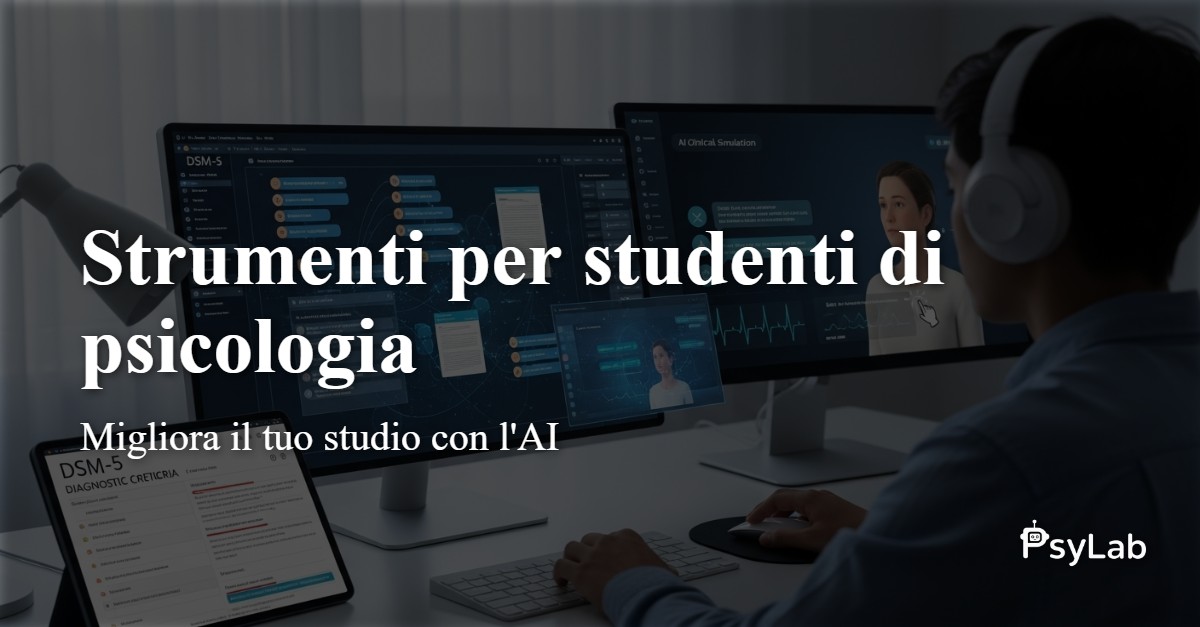
In this journey, a tool that deserves attention is PsyLab: an AI assistant designed for mental health professionals and in full harmony with training needs. With PsyLab you can simulate patient interviews, consult DSM-5 and ICD-11 quickly, organize chats into folders, create educational content for social media and build a digital business card for your professional networking.
App for effective note-taking
Notes apps are the foundation of your study ecosystem. More than choosing the right “name”, it is crucial to define a methodology consistent with your objectives: tracing key concepts, connecting theory and cases, preparing materials for exams and internships. Aim for a system that allows you to review and reuse notes when you really need them, for example during a clinical simulation or in case formulation.
How to set up your note-taking system
To build solid, reusable notes, create coherent outlines, actively synthesize, and reduce friction between theory and practice. A good workflow involves three steps: pre-lesson (anticipation of concepts), during the lesson (structured annotation), post-lesson (reformulation and integration with clinical examples). If you use concept maps, link them to diagnostic definitions; if you prefer summary sheets, always add “criteria, differential diagnosis, first line interventions”.
- Set consistent templates for each course with fixed sections such as objectives, key concepts, references and practice ideas;
- Make notes “alive”: add questions, short cases, keywords and links to authoritative resources;
- Integrate active review: transform complex concepts into questions and short quizzes that you will use in the following weeks.
Recommended workflow for lectures and study
Before class, read the chapter titles and write down three questions you would like to be able to answer at the end. During the lesson, capture logical points rather than whole sentences. After class, restate in your own words and create a clinical example for each core concept. At this stage, opening a dedicated chat in PsyLab can help you transform your notes into short simulations: guided practice reinforces learning and helps you grasp the nuances that often remain between the lines.
Clinical simulations and skills training
Simulations are the training ground where theory and practice meet. From initial interviews to medical history collection, from problem definition to psychoeducation, training in a protected environment helps you consolidate transversal skills such as active listening, reformulation and time management. With PsyLab you can simulate interviews with patients in a flexible way: start scenarios for anxiety, mood, sleep or relational issues and evaluate how the answers change as the questions change, always respecting the training limits.
Examples of scenarios for practice
Prepare a set of typical cases with varying degrees of complexity. Each scenario should include an interview objective, tentative hypotheses, signals to explore, and possible mistakes to avoid. Record the key steps, reflecting on ethical and cultural aspects. Avoid real identifying elements during training and favor the construction of plausible but didactically clear situations.
- Initial interview with generic request: focused on problem definition, duration, context, impact on functioning and protective factors;
- Short follow-up: train yourself to review goals, update hypotheses and monitor self-reported changes in a structured way;
- Psychoeducation: explains in a simple way concepts such as the sleep-wake cycle, physiological activation and avoidance, checking understanding.
Integration with supervision and ethical aspects
Simulations are not a substitute for supervision. Use the exercises to prepare targeted questions and discuss assessment or wording choices. Always pay attention to confidentiality: in your exercises in PsyLab work with fictitious or de-identified scenarios and focus the analysis on skills, processes and clinical decisions, not on sensitive data.
Resources DSM-5 and ICD-11: how to use them well
Knowing criteria and classifications is a necessary, but not sufficient, condition for solid practice. The key is to use DSM-5 and ICD-11 thoughtfully, integrating criteria, course, differential diagnosis, and cultural context. Official sources are essential for the study:
- DSM-5: consult the American Psychiatric Association website for updates and specific resources on criteria and changes over time. Source: psychiatry.org. - ICD-11: Explore the official World Health Organization browser for definitions, codes and inclusion notes. Source: icd.who.int.
In PsyLab you can consult DSM-5 and ICD-11 to quickly orient yourself between criteria and codes during the study or a simulation, reducing the time wasted between sheets and manuals and maintaining focus on clinical reasoning.
- Use criteria and codes as a “common language”: they will help you communicate clearly with teachers, colleagues and healthcare contexts;
- Train yourself in the differential: compare similar pictures, evaluate temporal factors, context, functioning and comorbidity to avoid overdiagnosis;
- Link criteria to intervention hypotheses: think in terms of measurable objectives and maintaining factors, not just labels.
From theory to practice: cases, notes, reflections
A good method is to build small “learning units”: for each disorder, create a sheet with essential criteria, main differential diagnosis, red flags, clinical vignette and a set of interview questions. Then, translate the card into a short simulation with PsyLab, observing what changes as your hypotheses change. This step transforms a static definition into a dynamic, process-centered competency.
Remember to alternate declarative learning (knowing the criteria) and procedural learning (knowing how to apply them): the first is measured with short-answer questions, the second with cartoons and role-play. Integrate the two registers and you will get fast and stable progress.
Organizing materials and contents during the internship
The organization is the bridge between study and the professional world. In PsyLab you can organize chats into folders by course, clinical area or competence: for example “anxiety and stress”, “mood”, “development”, “fundamental texts”, “interview simulations”. This allows you to quickly find materials and work towards progressive objectives, without wasting time and energy.
If you participate in seminars or workshops, create a dedicated folder in which you collect simulations, ideas and questions to bring to supervision. Maintain confidentiality rigor: do not include real identifying data and treat examples as teaching cases. When you need educational materials, use PsyLab to create content for social media on psychoeducational topics, maintaining an ethical tone and respectful of evidence.
For your networking, the digital business card generated with PsyLab is an easy way to introduce yourself to teachers, colleagues and facilities, facilitating contacts and opportunities. Remember that professionalism is also built with small habits: careful notes, reliable sources, frequent simulations and timely feedback.
Authoritative sources to keep close at hand
In addition to DSM-5 and ICD-11, consult institutional databases and portals to update your knowledge and train critical thinking. A third useful resource is the National Institute of Mental Health portal, with informative materials and references to clinical research: nimh.nih.gov. Integrate these sources into your notes and simulations: they will help you distinguish between opinions and evidence.
Transform your way of studying today with PsyLab
You’ve seen how Psychology Student Tools can accelerate your learning and make your path more solid and practice-oriented. Now is the time to create a coherent study environment: structured notes, frequent simulations, critical consultation of DSM-5 and ICD-11, folders organized by areas of expertise, and a professional presence ready to grow. Try PsyLab for free, the AI assistant for psychologists and mental health professionals: access from the web or app, practice with simulated interviews, organize chats in folders, consult diagnostic manuals and build your professional profile with the digital business card. Get started now on app.psylab.cloud and take your training to the next level today.