
What is teletherapy today
Tele-therapy is the provision of psychological or psychotherapeutic interventions remotely through digital tools. It can be synchronous (video call or real-time phone call) or asynchronous (messaging, exchange of materials), even in mixed form. In recent years it has become a structural component of the clinical offering, not just an emergency solution. International guidelines underline the need to integrate clinical skills and digital skills to ensure quality and safety: see the APA guidelines on telepsychology (American Psychological Association) and the EFPA document for telepsychology (European Federation of Psychologists’ Associations).
In Italy, the reference regulatory framework is the GDPR for the processing of personal and special category data, with specific attention to data minimization, security and informed consent. For a practical summary on the GDPR, the dedicated resource is useful (gdpr.eu).
Essential technical tools and security
Connection and hardware
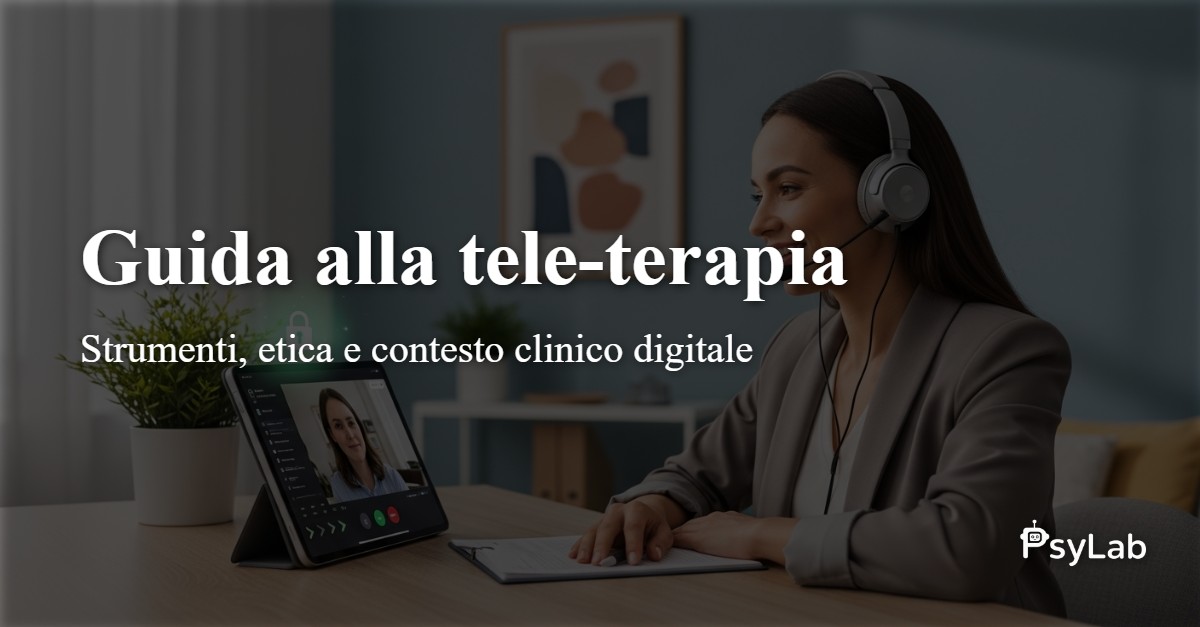
The quality of an online session largely depends on audio-video stability and clarity. For a professional standard, it is advisable to take care of both the technical side and the digital setting: reduce noise, illuminate the face well, plan a minimum redundancy (second device or backup network) and adopt headphones with a dedicated microphone. The workstation must also guarantee confidentiality: closed door, “do not disturb” signs, shared calendar with clear blocks.
- Devices and network: HD video camera, headphones with noise-canceling microphone, stable connection with adequate upload bandwidth (ideally ≥ 10 Mbps);
- Environment and physical privacy: dedicated room, basic soundproofing, neutral background, confidential documents not visible in the framed space;
- Operational continuity: plan B in case of interruptions (temporary switch to telephone), reliable power supply, software updates scheduled outside session hours.
Platforms and data protection
The choice of video calling platform is not neutral: preference should be given to solutions that offer robust encryption (ideally E2EE), server locations compatible with European requirements, granular control of privacy settings and data management. It is important to deactivate unnecessary functions (automatic recordings, unsolicited transcriptions) and clearly communicate to the patient the rules of use and potential residual risks. Even shared materials (worksheets, exercises, questionnaires) must pass through secure channels and remain archived according to the principles of privacy by design and by default.
Ethical and legal aspects
Specific informed consent
The informed consent for tele-therapy must cover additional aspects compared to the in-person study: nature of the remote intervention, indications and limits, technical risks, quality of connection, data processing, emergency management, use of any digital materials. Consent must be documented and archived with date, version of the document and method of acquisition. It is good practice to include operational rules (punctuality, reserved location, prohibition of unarranged recordings) and alternative contact channels in case of technical problems.
Urgency management and boundaries
In the absence of physical space sharing, the professional must prepare before starting: local emergency contact details of the patient, exact address of the place from which he will connect, a safety plan in case of acute risk and a clear procedure for interrupting and re-engaging the session. It is useful to contractualize the boundaries: hours of availability, times and channels for asynchronous messages, contact rules between one session and another, avoiding overloading the digital channel and respecting the boundaries of the clinical frame.
Clinical documentation
The clinical notes should report, in addition to the relevant contents, the medium used (video/telephone), any technical difficulties, the quality of the connection, any sending of materials, and the outcome of the security check (e.g. confirmation of the location and the absence of undeclared third parties). This helps both continuity of care and transparency in the event of an audit.
Online vs in-person sessions presence: what really changes
The most obvious difference is the setting: in the studio it is the therapist who takes care of space, silence and privacy; online these elements are shared and deserve explanation. The management of silence, the reading of non-verbals and the regulation of distance also change. Many patients appreciate flexibility and reduced downtime; others struggle to perceive the same intensity of the therapeutic alliance. Clinical experience suggests adapting the contract and method: defining clear objectives, segmenting the session, using sharing tools wisely (digital whiteboards, cards), calibrating the experiential exercises.
- Frequent advantages: facilitated access, continuity in case of travel or illness, reduction of logistical barriers and stigma;
- Recurring critical issues: screen fatigue, environmental distractions, loss of some non-verbal cues, technical vulnerability;
- Required skills: proactive management of the digital setting, micro-interventions to maintain engagement, explicit communication of sitting rules and emergency plans.
When to prefer remote or in-office
Indications
Tele-therapy lends itself well to psychoeducational interventions, structured CBT, continuous support for already known patients, follow-ups after intensive courses, and in all conditions in which mobility, time or distance limit access. It is often effective with digitally competent teenagers and adults, and in hybrid work contexts where online sitting avoids long commutes, without sacrificing quality.
Relative contraindications
High risk situations (active suicidal ideation without a support network), acute psychosis, serious substance use disorders, ongoing domestic violence or unsafe environments in which privacy cannot be guaranteed should be assessed with particular caution. In these cases, a face-to-face meeting or a referral to suitable services may be more appropriate. Even the “technological mismatch” between therapist and patient (low availability of adequate devices, poor digital literacy) can compromise the effectiveness of online work.
Integrate tele-therapy with PsyLab
PsyLab is an AI assistant created for psychologists, psychotherapists and mental health professionals. It does not replace video call platforms, but supports the clinician in a concrete way in the preparation, conduction and follow-up phases of remote sessions. Here are some useful uses for tele-therapy, in line with the available features:
Clinical and organizational preparation. You can ask PsyLab to help you define session schedules, exploratory questions and tracks for motivational interviews. The AI is already trained on clinical contexts and allows you to simulate interviews with patients to prepare delicate steps or crisis management role-plays. Additionally, you can quickly consult DSM-5 and ICD-11 for diagnostic clarification during planning.
Materials and psychoeducation. PsyLab supports you in creating psychoeducational sheets, homework and content for social media, useful for reinforcing your work between sessions. Organizing chats into folders allows you to separate different cases and projects, simplifying your workflow.
Professional visibility. If you offer tele-therapy, you can generate a digital business card with PsyLab that highlights available hours and contact channels, to share with patients and colleagues. Access via web or app makes the assistant always available, in the free version or with a monthly subscription.
Quality metrics and best practices
Monitoring quality helps maintain high clinical standards. Some useful indicators: rate of sessions completed, dropout, quality perceived by the patient, number and duration of technical interruptions, achievement of agreed objectives. It is advisable to introduce periodic reviews of the tele-therapy protocol, including technological updates, verification of compliance with GDPR and moments of supervision or intervision focused on the specific dynamics of online.
Practical start-up in 5 steps
Soon, we will analyze the 5 advantages most cited by clinicians when they structure their online service well. First, a short checklist to start safely and clearly, useful if you are integrating tele-therapy into your offer.
- Define the working model: inclusion/exclusion criteria, tools used, contact rules, contingency plan and cancellation policies;
- Prepare the documentation: specific informed consent for remote, GDPR-compliant privacy information, session start script (verify identity, location, privacy);
- Train the digital setting: technical test with a colleague, audio-video and light control, preparation of clinical materials to share and procedures for plan B.
Bring tele-therapy into your practice with PsyLab
Tele-therapy can broaden access, strengthen continuity of care and offer new clinical possibilities. To get the best out of it, you need solid tools, clear rules and targeted preparation. This is where PsyLab comes into play: an AI assistant designed for daily clinical work that helps you save time, prepare more effective sessions, simulate complex interviews, consult DSM-5 and ICD-11, organize your activities and create materials for patients and professional communication. Try it for free today: app.psylab.cloud.