
What do we mean by digital psychotherapy
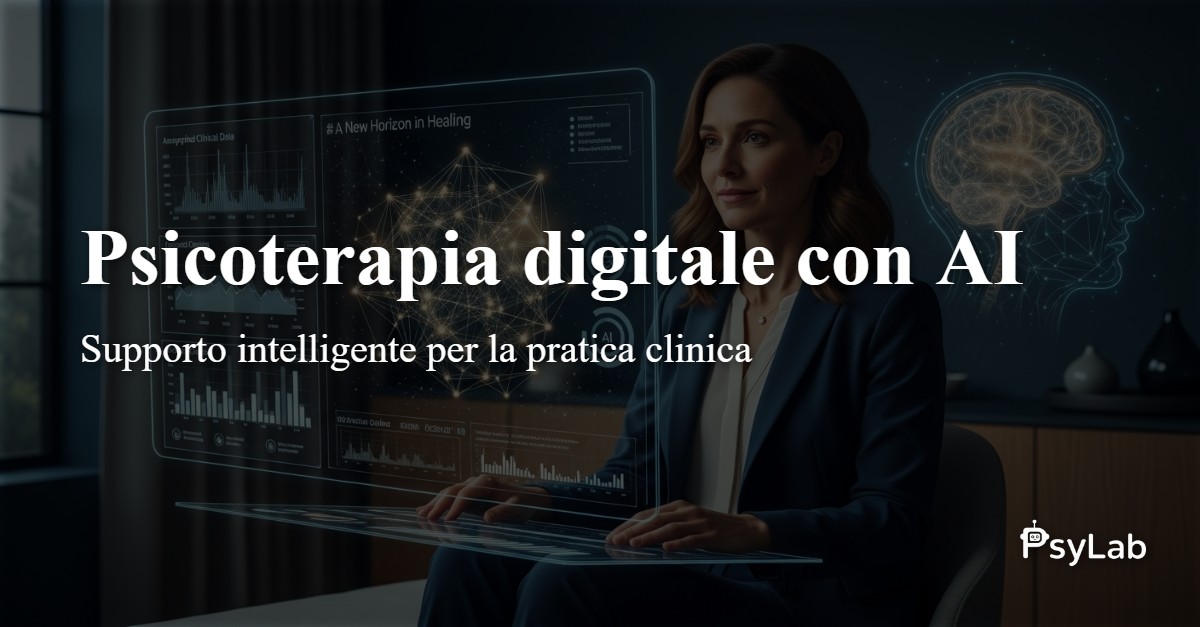
With digital psychotherapy we refer to the use of technological tools to support the evaluation, treatment and organization of clinical work. In this framework, AI does not replace the therapist, but can enhance decisions, processes and results. It is important to distinguish between the provision of remote psychotherapy (telepsychology) and the use of AI as an assistant: the first concerns the setting and channels, the second the way in which you analyse, organize and communicate clinical information. Both levels require rigorous ethical standards, data protection and ongoing clinical supervision.
International bodies have been highlighting guiding principles for technology in mental health for years. The APA Telepsychology Guidelines emphasize competence, safety, and confidentiality; the World Health Organization published a report on ethics and governance of AI in healthcare; At the European level, the new AI Act outlines transparency and risk management obligations. These frameworks help integrate AI into clinical work in a responsible way.
Why consider AI in psychological support
Soon, we will analyze the 5 advantages that the combination of clinical expertise and AI can offer. When used methodically, AI helps reduce preparation times, structure reasoning and improve the quality of psychoeducational communication. In other words, it is an accelerator of your workflow, not a substitute for the therapeutic relationship.
- Organisation and clarity: synthesize anamnestic data, session notes and hypotheses into readable schemes, reducing the cognitive load in the preparatory phases;
- Decision support: explore case formulation alternatives and diagnostic criteria, keeping clinical judgment as the main reference;
- Psychoeducation: creating understandable explanations of symptoms and treatment models adapted to the patient’s literacy level;
- Training and reflexivity: simulate interviews to try open questions, reformulations and goal negotiation strategies;
- Access to resources: Quickly consult diagnostic manuals such as DSM-5 and ICD-11 to compare criteria and specifiers.
Limitations, risks and ethics: what not to delegate to AI
Professional practice remains centered on the relationship, ongoing evaluation and the patient’s context. AI can reduce distracting errors, but it cannot capture relational nuances, paralinguistic signals or transferential dynamics with the sensitivity of an expert clinician. For this reason, responsible use requires clear boundaries and shared procedures in the study.
- Does not replace diagnosis and treatment: the AI does not formulate official diagnoses, does not indicate interventions without verification and does not make clinical decisions for you;
- Bias and hallucinations: models can reproduce prejudices or generate plausible but inaccurate content, always requiring verification and critical thinking;
- Privacy and consent: it is necessary to inform the patient about the use of digital tools and define what is shared, for what purposes and for how long;
- Transparency and traceability: document when and how algorithmic assistance contributed to clinical reasoning, to promote accountability and internal audits.
PsyLab as a support tool, not a substitute
PsyLab is an AI assistant designed for psychologists, psychotherapists and mental health professionals. It is accessible via the web and app, available in a free version and with a monthly subscription. His role is to support you in activities with low relational value, so as to leave more time and attention to the therapeutic relationship.
Case-oriented management
With PsyLab you can communicate with an already trained AI and organize chats into folders, separating thematic areas, paths or projects. This allows you to maintain an orderly view of the reflections, ideas and drafts connected to your cases. The goal is to make information more accessible, improving continuity and coherence of your clinical work.
More effective professional communication
PsyLab helps you create clear messages for psychoeducation, reminders or summaries for colleagues, avoiding unnecessary technical jargon when it is not needed. You can generate information materials, session plans and social media content geared towards outreach and prevention, while maintaining control of tone and scientific precision. At all times, the professional remains the final decision maker on the final version.
Rapid consultation of resources reliable
Inside PsyLab you can consult DSM-5 and ICD-11 to compare criteria and specifiers, as well as ask the assistant for theoretical and methodological clarifications. This feature accelerates hypothesis testing, allowing you to stay anchored to standard diagnostic references without interrupting your workflow.
Continuous training and simulations
The interview simulations are useful for preparing you for complex situations, training management and reflecting on questions, times and micro-interventions. It is a safe testing space, a sort of sandbox where you can train skills and refine your style, with the AI returning ideas and counter-questions to enrich your reflection.
How to use PsyLab in practice, day by day
Integrating PsyLab into your work requires no upheavals. You can start with small routines and measure their impact on time, clarity and quality of clinical documentation.
- Before the session: ask the AI for a brief summary of the previous notes and a proposed agenda, to enter the session with a clear focus;
- After the session: generate a draft structured note (events, emotions, cognitions, behaviors, interventions) and review it critically before archiving it;
- Psychoeducation: develops explanations of symptoms and treatment rationales suited to the patient’s age and level of literacy;
- Study and compare: quickly consult DSM-5 and ICD-11 for differentials and specifiers, always keeping the final decision as a clinical responsibility;
- Professional visibility: create informative content for social media and a digital business card consistent with your positioning, so as to communicate in a professional and accessible way.
Responsible integration into the clinical setting
To align technology and ethics, define an internal protocol that includes: when and why to use AI; what data to insert or anonymize; how to cite any algorithmic contribution in the notes; how to carry out periodic reviews of the quality of the generated texts. Maintaining a reflective posture is crucial to prevent production speed from reducing clinical depth.
From a practical perspective, consider a document management policy that separates drafts, psychoeducational materials and reflective notes. Use AI to speed up repetitive steps and free up time for interviewing, supervising and studying complex cases. Finally, monitor the outcomes over time: for example, how much PsyLab helps you reduce omission errors in notes, speed up the consultation of diagnostic criteria or clarify language and treatment objectives. This approach allows you to adopt AI as a quality lever, not a shortcut.
Bring digital psychotherapy into the office with PsyLab
Digital psychotherapy works when AI extends your skills without replacing them. With PsyLab you can organize ideas and materials in folders, simulate interviews, quickly consult DSM-5 and ICD-11, create clear content and a digital business card, always maintaining clinical control and the ethical quality of your work. Try it in your daily life and see how it improves your workflow and professional communication. Get started now: try the PsyLab app for free.