
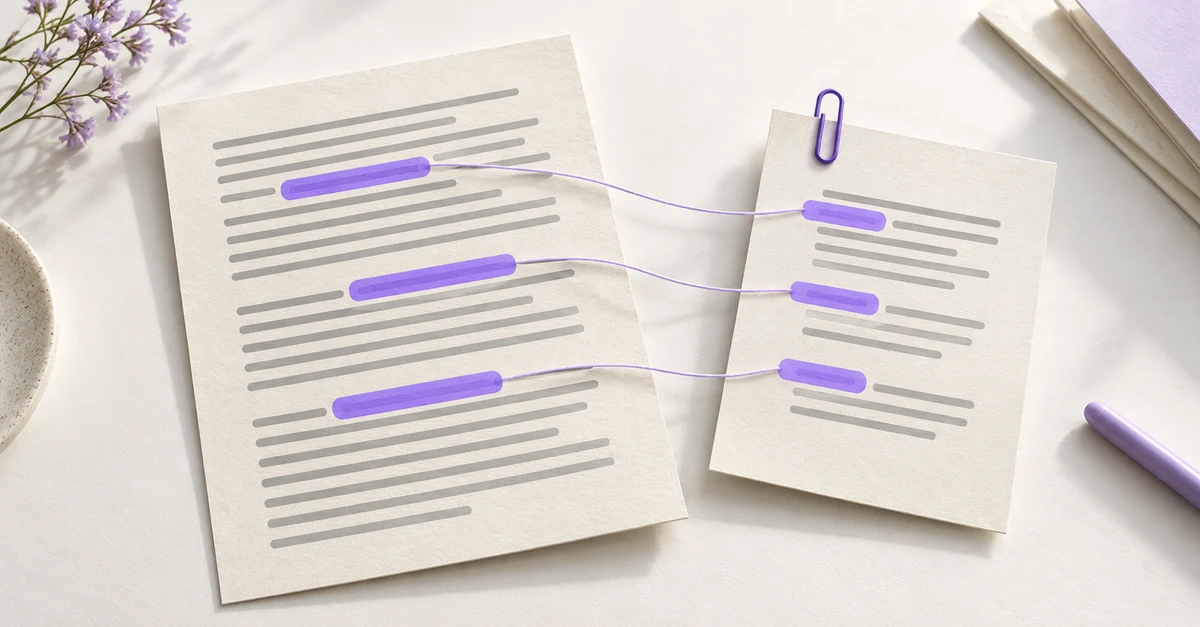
You have read a useful document and want a shorter version for a discussion with colleagues. You ask AI to summarize it. The result reads smoothly, yet one sentence sounds more certain than the original and a limitation has disappeared. Before using that summary, you need a comparison that goes beyond matching words.
For psychologists and psychotherapists, this might involve training materials, a paper they have already read, or their own notes. The task is specific: make the text shorter while preserving its information, conditions, and uncertainty. We can work through the request and the review using a completely invented example, with no information about real people.
Decide what needs to survive
Before requesting a summary, clarify its purpose. A personal note for finding a passage later needs different information from an introduction for colleagues. Identify the audience, the function of the summary, and the part of the document you want to use. Length comes after these decisions: a word limit alone cannot decide what matters.
For a research paper, first identify the question, participants, comparison, outcome, and limitations actually described. For a training programme, preserve the activities, participation conditions, and what the programme does not promise. Different documents need different structures. You should be able to explain why a particular piece of information must remain when the text becomes shorter.
Distinguish faithfulness from source accuracy
A summary can reflect its document and still repeat a claim that needs checking. Comparing the summary with the original checks the relationship between those texts; assessing the basis of the original is a separate task. If you are summarizing an opinion, its appearance in the source does not turn it into an established finding.
A 2020 study by Maynez and colleagues distinguishes document-supported content from additions or distortions in automatic news summaries. It concerns those systems and that setting, not PsyLab’s current performance. We use the distinction here without treating it as a validated procedure for psychological practice.
Start with a bounded excerpt
Use material you own or are authorized to use, and mark where the excerpt begins and ends. Keep its title, author, and location when available. If you have only one paragraph, say that the summary covers that paragraph. Do not present it as a summary of the entire study. The passage below is original and wholly fictional.
“Twelve students attended an imaginary workshop on reading research papers. At the end, they described how prepared they felt to recognize a study’s limitations. Their responses expressed greater confidence than at the beginning. There was no skills assessment, comparison group, or later follow-up.”
The passage describes a reported perception, the timing of the responses, and three things that were absent. It does not describe a measured improvement in skills. You can identify those points before reading any AI proposal. They will guide the comparison without giving the imaginary workshop scientific standing or turning its fictional observations into evidence.
Make the request reviewable
You could begin with this original instruction: “Summarize only the excerpt between the delimiters for psychologist colleagues, in one short paragraph. Keep the participants, what was recorded, timing, and limitations. Do not add explanations, findings, or external references. Flag unclear parts separately. After the summary, identify the source sentences supporting each claim.”
The instruction makes the expected task visible, but it does not technically prevent the AI from making mistakes. Any links it proposes between a claim and a source sentence also need checking. The 2024 NIST Generative AI Profile, in its confabulation section, includes outputs that diverge from the input. Writing a constraint therefore does not establish that the output follows it.
Compare one sentence at a time
Imagine this problematic version, also invented: “The workshop improved students’ ability to evaluate research, with lasting benefits.” It is concise, but introduces both a measured ability and a duration that the excerpt does not document. It also strengthens the conclusion: a description of responses becomes an effect attributed to the workshop.
A more faithful proposal might be: “After an imaginary workshop, twelve students reported greater confidence in recognizing study limitations; skills, differences from other groups, and persistence over time were not assessed.” This is not the only possible wording. Its usefulness lies in allowing you to trace both the main information and its limits back to the original passage.
Apply the same comparison to each sentence in the summary. Who performs the action? What was observed? Does the source describe a possibility, a proposal, or a finding? A word such as “may” is not decoration to remove simply to make a sentence sound firmer. Check negations, timing, and references to groups rather than relying only on the presence of familiar terms.
Look for consequential omissions
A summary selects information, so some material will be left out. Ask whether one of those omissions might change how a reader understands the finding. In our example, removing the type of response leaves room for the impression that participants took a skills test. Removing every limitation makes it easier to read the paragraph as evidence of effectiveness.
The CDC instructions for using the Clear Communication Index recommend checking that a summary matches its content and making knowns and unknowns visible. These are communication guidelines, not certification of AI summaries. In your own work, keep a short note of what you omitted and why you made that choice.
An omitted detail is not automatically an error. Its importance depends on the purpose established at the start. A logistical detail may be unnecessary in a methodological note, while the nature of the outcome may be essential. Review that decision against the intended use, not against a general desire to make every paragraph shorter or more persuasive.
Keep the comparison for later use
If a short paragraph cannot accommodate an essential limitation, reconsider its length or narrow its purpose. Asking for another version may provide an alternative, but does not replace reading the original. When a passage remains ambiguous, return to the document or leave the check open instead of completing it with a plausible explanation.
Keep the excerpt, request, revised summary, and reference to the relevant section together. This record makes it easier to correct the material when the document changes or when a colleague asks where a sentence came from. It does not prove that the summary is infallible. It gives you a way to retrace the choices that produced the final paragraph.
PsyLab is a digital AI workspace for mental health professionals, including Chat and tools for preparing documents. It can support drafting, while comparison with the sources remains the professional’s responsibility. You can try PsyLab for free using a short text of your own: first decide what must remain, then check that the summary actually preserves it.